Literally, adv. The OED
recognises the following meanings:
†1.1 nonce-uses. a By the letters
(of a name). b In letters or literature. Obsolete.
1593 R. Harvey Philad. 7 And yet I tell you me-thinkes you are very
bookishly and literally wise.
2. a With reference to a report,
translation, etc.: In the very words, word for word. b transf. With exact
fidelity of representation.
3. a. In the literal sense. 3. b
Used to indicate that the following word or phrase must be taken in its literal
sense.
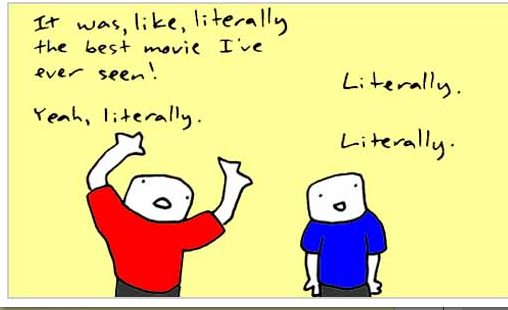
Now often improperly used
to indicate that some conventional metaphorical or hyperbolical phrase
is to be taken in the strongest
admissible sense, e.g. 1863 F. A. Kemble Resid. in Georgia 105 For the last four years.. I literally coined
money.
I have always been fascinated by
the use of the adverb literally, both
in English and in French. I was brought up, very firmly, to use this adverb to
mean, and this would admit of no exception, in
the literal sense, as in the OED’s definition 3 above. The note at the end
points out an ‘improper’ usage: I
literally coined money. It would never occur to me to say something like
this, so effectively have I been trained not to. It’s like unique which must never be qualified; rather/very unique are not acceptable. If you do accept this, then
you must also accept that someone can be a
little pregnant. As an afterthought, I do like the use in definition 1
which is today unfortunately obsolete and has been replaced by literarily.
In France, the situation is more fluid.
Littéralement, adverb.
Larousse gives the following two
possible meanings :
D'une manière littérale, à la lettre : Traduire
littéralement. This is the same as senses 2 and 3 of the OED.
Absolument, tout à fait : Il
était littéralement épouvanté. [he was literally frightened/shocked]. Here we have the equivalent
of the qualifiers absolutely or quite. But it is still parallel to
English usage; one can be literally frightened.
Larousse goes on to make the following recommendations:
‘Littéralement au sens de « à la
lettre, dans un sens strict » s'emploie
dans tous les registres : traduire un texte littéralement ; au sens de « très, à l'extrême » (il est littéralement épuisé), le mot
relève de l'expression orale non surveillée.’ It confirms that the
adverb should be used as in the two French definitions, but suggests that this
usage belongs to the register of spoken language, spontaneous, not careful French.
Larousse goes on to recommend
that in careful speech and in writing littéralement
should be replaced by completely, extremely etc. ‘Dans l'expression soignée, en particulier à
l'écrit, préférer les équivalents : complètement, extrêmement, au plus haut
point, au plus haut degré, etc.’
Here is an example of the use of
this adverb which is typical of its use in current French. The caption
accompanies a photo of an object under water: Cet élément qui appartenait au Titanic a été littéralement pulvérisé
lors du choc.[This object from the Titanic was literally pulverised on
impact].
It’s all the more improbable as the concepts of underwater
and powder are incompatible.
This leads neatly onto the verb pulverise which behaves in a similar way to literally and derives from the Latin pulver for powder. In French,
pulveriser has these definitions
[from Larousse]:
Réduire une matière en
poudre : Pulvériser de la craie ; du charbon. {pulverise chalk]
Projeter un liquide en très
fines gouttelettes : Pulvériser de l'eau sur une plante. [water, spray]
Réduire quelque chose en miettes, en morceaux :
Les bombes ont pulvérisé l'objectif. [smash]
Anéantir quelqu'un, un groupe, le vaincre de
manière écrasante : Pulvériser l'ennemi. [destroy]
In English, we have the same meanings as in French, but the reference
to liquid in definition 1b is now rare and has been superseded by spray.
1. trans. To reduce to powder or dust; to comminute, to
triturate. Also refl.
b. techn. To divide (a liquid) into minute particles or
spray.
2. fig. To
demolish or destroy, to break down utterly; to ‘smash’. “ The four battalion were
pulverised... “ [The OED favours the spelling with ‘z’. I prefer the ‘s’
spelling].
In French, we find: Le gel du 18 août
et celui qui est survenu début septembre ont littéralement décimé les récoltes.
[The frosts … literally decimated the crops]. Here again we have this
particular French usage of literally and decimate.
English would not say literally decimate,
although it often uses this verb to mean destroy as in French. Both English and French agree that the careful
use of this verb means:
To kill, destroy, or remove one in every ten of, but accepts the
meaning, rhetorically or loosely, to destroy or remove a large proportion of;
to subject to severe loss, slaughter, or mortality. (OED)
In French, décimer,
(Latin decimare) has the same values as in English. Words mostly share the same
meanings in different languages, but can differ hugely in the way they are used,
especially in the spoken idiom.

