Showing posts with label OED. Show all posts

Sunday, 16 October 2016

Literally speaking

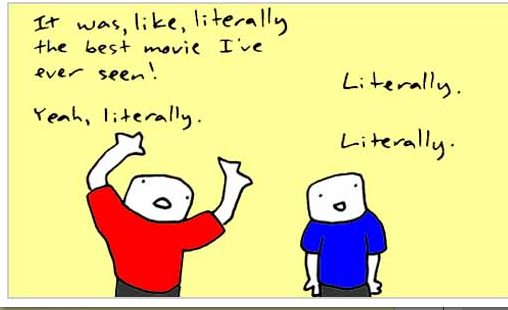
Literally, adv. The OED recognises the following meanings:
†1.1 nonce-uses. a By the letters (of a name). b In letters or literature. Obsolete.
1593 R. Harvey Philad. 7 And yet I tell you me-thinkes you are very bookishly and literally wise.
2. a With reference to a report, translation, etc.: In the very words, word for word. b transf. With exact fidelity of representation.
3. a. In the literal sense. 3. b Used to indicate that the following word or phrase must be taken in its literal sense.
 Now often improperly used to indicate that some conventional metaphorical or hyperbolical phrase
is to be taken in the strongest admissible sense, e.g.   1863 F. A. Kemble Resid. in Georgia 105 For the last four years.. I literally coined money.

I have always been fascinated by the use of the adverb literally, both in English and in French. I was brought up, very firmly, to use this adverb to mean, and this would admit of no exception, in the literal sense, as in the OED’s definition 3 above. The note at the end points out an ‘improper’ usage: I literally coined money. It would never occur to me to say something like this, so effectively have I been trained not to. It’s like unique which must never be qualified; rather/very unique are not acceptable. If you do accept this, then you must also accept that someone can be a little pregnant. As an afterthought, I do like the use in definition 1 which is today unfortunately obsolete and has been replaced by literarily.

In France, the situation is more fluid.
Littéralement, adverb.  Larousse gives the following two possible meanings :
D'une manière littérale, à la lettre : Traduire littéralement. This is the same as senses 2 and 3 of the OED.  
Absolument, tout à fait : Il était littéralement épouvanté. [he was literally frightened/shocked]. Here we have the equivalent of the qualifiers absolutely or quite. But it is still parallel to English usage; one can be literally frightened.
Larousse goes on to make the following recommendations:
‘Littéralement au sens de «  à la lettre, dans un sens strict  » s'emploie dans tous les registres : traduire un texte littéralement ; au sens de «  très, à l'extrême  » (il est littéralement épuisé), le mot relève de l'expression orale non surveillée.’ It confirms that the adverb should be used as in the two French definitions, but suggests that this usage belongs to the register of spoken language, spontaneous, not careful French.
Larousse goes on to recommend that in careful speech and in writing littéralement should be replaced by completely, extremely etc. ‘Dans l'expression soignée, en particulier à l'écrit, préférer les équivalents : complètement, extrêmement, au plus haut point, au plus haut degré, etc.’
Here is an example of the use of this adverb which is typical of its use in current French. The caption accompanies a photo of an object under water: Cet élément qui appartenait au Titanic a été littéralement pulvérisé lors du choc.[This object from the Titanic was literally pulverised on impact].
It’s all the more improbable as the concepts of underwater and powder are incompatible.

This leads neatly onto the verb pulverise which behaves in a similar way to literally and derives from the Latin pulver for powder. In French, pulveriser has these definitions [from Larousse]:
Réduire une matière en poudre : Pulvériser de la craie ; du charbon. {pulverise chalk]
Projeter un liquide en très fines gouttelettes : Pulvériser de l'eau sur une plante. [water, spray]
Réduire quelque chose en miettes, en morceaux : Les bombes ont pulvérisé l'objectif. [smash]
Anéantir quelqu'un, un groupe, le vaincre de manière écrasante : Pulvériser l'ennemi. [destroy]

In English, we have the same meanings as in French, but the reference to liquid in definition 1b is now rare and has been superseded by spray.
1. trans. To reduce to powder or dust; to comminute, to triturate. Also refl.
b. techn. To divide (a liquid) into minute particles or spray.
2. fig. To demolish or destroy, to break down utterly; to ‘smash’. “ The four battalion were pulverised... “ [The OED favours the spelling with ‘z’. I prefer the ‘s’ spelling].

In French, we find: Le gel du 18 août et celui qui est survenu début septembre ont littéralement décimé les récoltes. [The frosts … literally decimated the crops]. Here again we have this particular French usage of literally  and decimate. English would not say literally decimate, although it often uses this verb to mean destroy as in French. Both English and French agree that the careful use of this verb means:
To kill, destroy, or remove one in every ten of, but accepts the meaning, rhetorically or loosely, to destroy or remove a large proportion of; to subject to severe loss, slaughter, or mortality. (OED)
In French, décimer, (Latin decimare) has the same values as in English. Words mostly share the same meanings in different languages, but can differ hugely in the way they are used, especially in the spoken idiom.


Saturday, 6 August 2016

Men’s language and women’s language

With thanks to Penguin Books
for this image..
There was a time, maybe fifty years ago, when English had a class of vocabulary known as “men’s language” as opposed to “women’s language”. This men’s language was a group of swear words and expressions which could only be uttered by men and then, usually, by men of the lower orders. Polite society never used them and did not recognise their existence, or would not admit to knowing them. I’m talking of course about the infamous trio:  f**k, c**t, t**t. Even now, with them all covered in asterisks, I find it shameful to write them. There are others, but these three are at the top of the tree and in ascending order of horribleness. Women’s language doesn’t exist in this context; the expression is used simply to countervail men’s language. Women’s language has the value of all that is correct, acceptable and pleasant to hear. Well, that’s how things were, Jane Austen-y I suppose.

The OED not only admits to knowing about this trio, but gives full-blooded definitions and etymologies. Even the Oxford Learner’s Dictionary shows them, with remarks like “taboo, slang” and “offensive” somewhere in the definition. Fifty years ago, these words would not have been published, anywhere, there would have been an instant hue and cry. How many, today, remember the prosecution of Penguin Books under the Obscene Publications Act for having published D. H. Lawrence’s Lady Chatterley’s Lover? The trial was held at the Old Bailey in 1960 and a unanimous verdict of not guilty was returned. It was seen as a test case opposing modern progressive culture and public morals and decency. Modern cultural expression won and so began the Permissive Society. The result of this trial is the presence in dictionaries of this trio. Today, almost any vocabulary is printable. Philip Larkin recalls this case, with his inimitable “serious” humour, in his poem Annus Mirabilis:

“Sexual intercourse began
In nineteen sixty-three
(which was rather late for me) -
Between the end of the Chatterley ban
And the Beatles' first L.P.”

And in This Be The Verse his famous first line: “They fuck you up, your mum and dad.” would never have been published a dozen years earlier, but both were published in High Windows in 1974.

Today, in the age of feminism and equality of everything for everybody, these “men’s” words are now used by everybody, men and women alike. Young women now share laddish behaviour and violence, get drunk and fight outside pubs on a Saturday night; why shouldn’t they use these words? They are now banal.

That being said, I should recommend that they not be used by learners of English. In fact, I should recommend that they not be used by anybody in normal, polite, conversation or writing. When learners use them, it doesn’t ring true; there’s a conflict between a lack of mastery of the language and the native-speaker ability associated with these words. One final indication or test of fluency is the native-speaker ability to insert f***king between an adjective and its noun or between two nouns: “I hate the noise of a Harley f***king Davidson” or “not warm f***king beer!" This takes skill and it’s not quite the same as “f***king warm beer”, so be warned!


As I often say, standards only go in one direction, downwards.

Wednesday, 27 July 2016

Advice on the kind of English to learn and use

The Complete OED
Below, there are two paragraphs. The first is written and inspired using the clichés and fashionable jargon of business and financial reporting. The second is the same paragraph rewritten in what I think is more usual, more acceptable English. Both versions have the same number of words.

Downside is quite a common expression, but the way it is used here makes absolutely no sense to me. Today, there is no Authority for English language usage. There never has been an English Academy like the French or Spanish ones, but in the past, there were Fowler, Gower, the Society for Pure English and the Committee on Spoken English of the BBC. Alas, they are no more. The BBC can no longer claim to set any standard. The Oxford English Dictionary is perhaps all we have left, and its standard is that of vocabulary, for which we should be thankful.

The challenge facing learners of English is whether to learn this type of buzzword and, if yes, whether to use it. Depending on your level, my advice would be to be aware of these words but not to use them in writing, and definitely not to use them in spoken English. Used by native English speakers, they offend my ear, used by non-native speakers they sound wrong, out of place, out of register. It’s better to concentrate on more standard usage and vocabulary in the early stages. When you attain mastery, you can do whatever you like. When you begin learning English, your teacher and your course books are the Authorities and I hope they are not using this style of English.

It could be said that these buzzwords have value in the sense [note the correct use of sense here] that they add something to the meaning, they provide nuance. Sometimes this is true, but mostly it is not. Basis points adds nothing that standard fractions and percentages do not already have, and will, therefore, very probably disappear before long. It’s a question of training and experience, but data just screams plural. I have a suspicion that Latin plurals may be on the way back, owing probably to the many people interviewed on television using referendum-a after Brexit. Football stadium-a also seems to be making a comeback. Anyway, I hope you enjoy thinking about this and watching out for other examples in your daily life.

Paragraph 1
The government's numbers give no sense of the true numbers involved. There is an uptick, sure, but this is one of multiple upticks; there have also been multiple spikes and hikes. Stability is not about to return anytime soon to the markets. Investors will continue to be hit by this volatility until companies pivot their growth away from European markets and deliver value for money. Airlines that operate intra EU routes will probably be secure post Brexit but there are significant risks to the downside going forward. There is no chance the data over the next few weeks is going to suddenly improve and losses will continue to increase big time. Any increase over 25 basis points would negatively impact companies. (121 words)

Paragraph 2

The government's figures give no indication of the true numbers involved. There is clearly a slight increase, but this is one of several; there have also been numerous larger increases. Stability is not about to return to the markets in the near future. Investors will continue to suffer from this volatility until companies move their growth away from European markets and provide value for money. Airlines that operate routes within the EU will probably be secure after Brexit but there are significant future risks […to the downside???]. There is no chance the data are suddenly going to improve over the next few weeks and losses will continue to escalate. Any increase above one quarter percent would have a negative effect on companies. (122 words)